You have been publishing for months. Blog posts go up, maybe two or three a month, and traffic barely moves. When a business owner brings me that problem, the cause is almost never the writing. It is the absence of a plan. So what is a content roadmap? It is the strategic document that decides what you publish, in what order, and why, before a single word gets written. It connects your business goals to specific topics, priorities, and timelines. Most struggling blogs do not have one, and it shows in their analytics.
What is a content roadmap?
A content roadmap is a quarter or year-long plan that ties each topic you publish to a business goal, a search query and a stage of the buyer’s journey. It decides what gets written, in what order and why. A content calendar only decides when.
In practice, I treat the roadmap as the answer to one question: if we could only publish ten pieces this quarter, which ten would move revenue? Everything else waits.
A good roadmap answers four questions in advance:
- What topics and formats you will produce, grouped into themes or clusters
- Why each one exists, tied to a goal like leads, rankings, or authority on a subject
- When each phase happens, sequenced by priority rather than by whim
- Who is responsible for research, drafting, review, and publishing
It sits between your overall content strategy and your day-to-day calendar. The strategy says where you want to go. The roadmap says which route you will take. The calendar just tells you what ships on Tuesday.
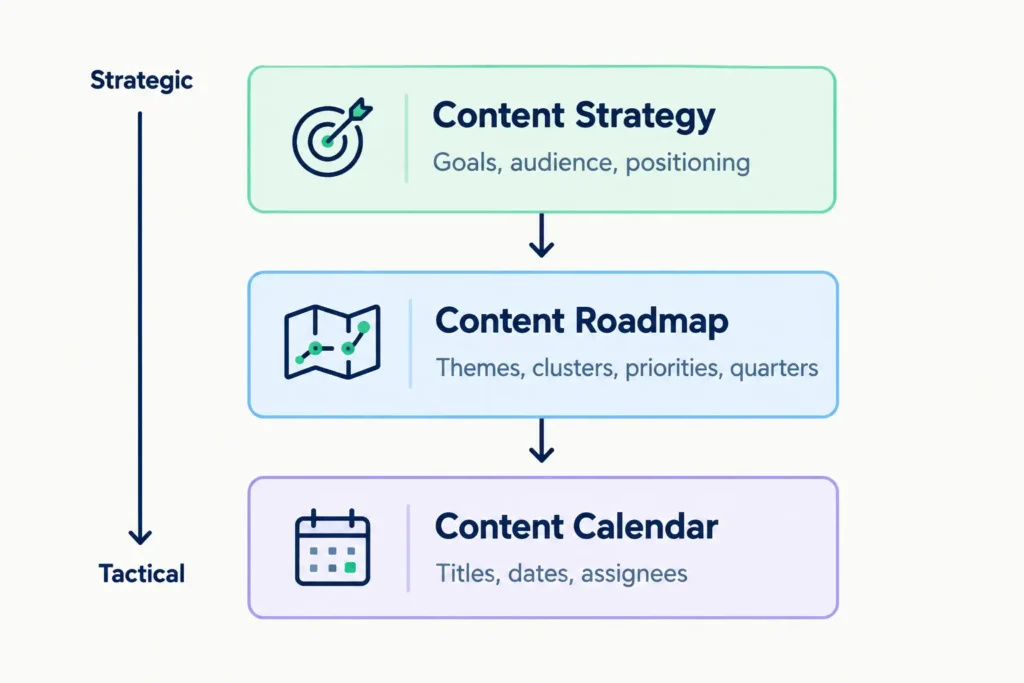
Content roadmap vs content calendar
Most teams I work with have a calendar and think it is a roadmap. The difference shows up when traffic stalls: a calendar tells you what went out, a roadmap tells you whether it was the right thing to publish.
| Content roadmap | Content calendar | |
|---|---|---|
| Time frame | Quarter or year | Week or month |
| Answers | What and why | When and who |
| Built from | Business goals, keyword data, buyer stages | The roadmap |
| Unit of planning | Topic clusters and priorities | Individual posts and dates |
| Changes when | Goals or search demand change | Deadlines slip |
| Owner | Strategy lead or consultant | Editor or content manager |
You need both. But if you only have a calendar, you have a to-do list, not a plan.
What goes into a content roadmap
Every roadmap I build for a client contains the same core parts, whatever the industry:
- One goal per quarter. “More leads from organic search for the kitchen remodel service” beats “grow traffic”. A roadmap with four goals is a wishlist.
- Keyword and demand data. Search volume, current rankings and which pages already get impressions in Search Console. This is where most roadmaps are weakest, because they are built from ideas instead of data.
- Buyer stage for every topic. Awareness, comparison or decision. On the service-business sites I audit, the decision stage is almost always the gap: plenty of “what is” posts, almost no pricing, comparison or “near me” pages.
- Existing content first. Pages to update or merge go on the roadmap before new ones. Improving a page that ranks on page two is usually faster than earning a new ranking.
- A priority order. Every item gets a rank. Pages closest to revenue, or where the competition is weakest, go first. The rest can wait for next quarter.
- Internal link targets. Each new piece names the service page it supports, so the roadmap builds topic clusters rather than a pile of loose posts.
- Milestones and owners. Who drafts, who reviews and the month each item is due. Without names and dates, roadmap items drift into the next quarter.
- A success measure per item. Impressions, position or leads, checked at a fixed date.
Notice what is not on the list: publishing frequency for its own sake. Cadence matters less than sequence.
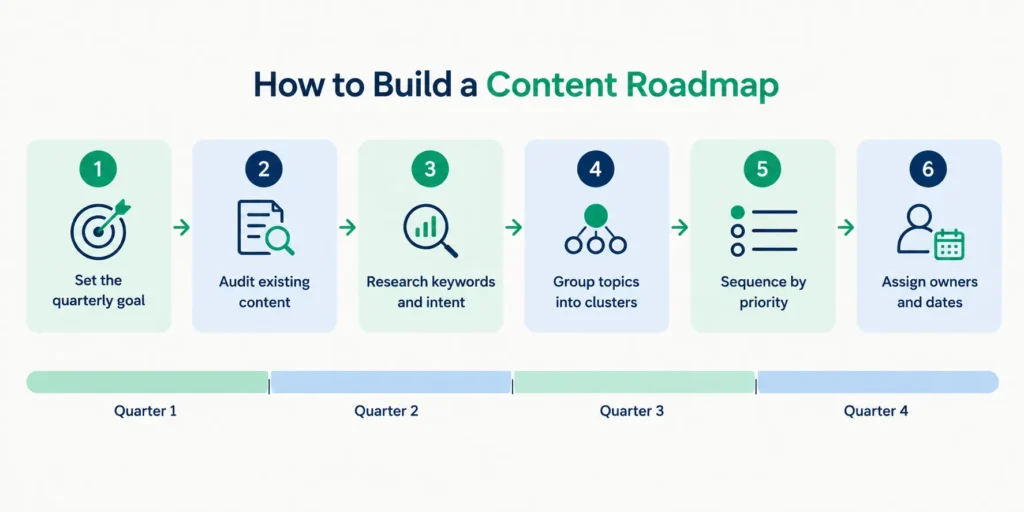
Content roadmap example: one quarter for a local service business
This is the shape I use for a local service business. The topics are illustrative, the structure is the part to copy.
| Month | Priority | Topic | Buyer stage | Type | Supports | Measure |
|---|---|---|---|---|---|---|
| Month 1 | Protect | Rewrite main service page to match search intent | Decision | Update | Service page | Position for main service query |
| Month 1 | Protect | Merge two overlapping cost posts into one | Comparison | Merge | Service page | Clicks to merged URL |
| Month 1 | Grow | “[Service] cost in [city]” | Decision | New | Service page | Leads from page |
| Month 2 | Grow | “[Service] vs [alternative]: which one fits” | Comparison | New | Service page | Impressions, position |
| Month 2 | Grow | “How long does [service] take” | Comparison | New | Service page | Impressions |
| Month 3 | Grow | Case-style walkthrough of a typical project | Decision | New | Contact page | Leads |
| Month 3 | Review | Check month 1 changes in Search Console | n/a | Review | n/a | Keep, adjust or cut |
Why Publishing Without a Roadmap Fails
Random publishing fails for a structural reason, not a quality reason. Google ranks sites that demonstrate depth on a topic, and depth comes from clusters of related pages that support each other. Twenty posts on twenty unrelated topics build authority on nothing.
I see this constantly in audits. A typical site I review has 40 to 80 published posts, and fewer than ten of them bring any meaningful search traffic. The topics were chosen one at a time, usually based on whatever felt interesting that week, so there is no cluster deep enough to rank and nothing holding the pages together.
The research backs this up. In Content Marketing Institute’s B2B benchmark studies, only about 37 percent of marketers have a documented content strategy, while 62 percent of the organizations that succeed at content marketing do. The pattern has held for years across their reports. Writing the plan down is one of the clearest dividing lines between blogs that grow and blogs that stall.
If your traffic has been flat despite steady publishing, this is one of the first things I would check, alongside the technical issues I’ve covered in a separate breakdown of stalled sites.
How I Build a Content Roadmap for Clients
My process starts with what already exists, not with new ideas. I audit the current content first, because in most engagements the fastest wins come from fixing and consolidating pages the site already has. Then I pull live keyword and SERP data to find the clusters where the site can realistically compete, map search intent for each target, and sequence everything by expected impact.
The output is a working document, not a slide deck. You see every planned page, the keyword behind it, where it links, and roughly when it ships. It pairs directly with the optimization work I do on each page, since a roadmap tells you what to write and execution decides whether it ranks.
Seowithsaif really gets it done! They helped rank my UGC business higher on google search. I also started showing up in ChapGPT results which was a huge bonus. Highly recommend this guys for websites and SEO! – ” Bo Green”
One honest caveat. A roadmap is not a guarantee of rankings, and anyone who promises you one is selling something. What it does is remove the most common cause of wasted content budget, which is effort pointed in no particular direction. How fast results arrive depends on your niche, your site’s authority, and how consistently the plan gets executed.
Muhammad delivered excellent work on this SEO and optimization project, and I truly enjoyed working with him. Over the course of our 8-month collaboration, his strategies led to over 400% increase in customer leads – helping us outperform even larger competitors in our saturated industry. I highly recommend Muhammad, and will absolutely work with him on other projects too when they will come out. ” Alessio Ligabue” – Alessioligabue.it
FAQs About Content Roadmaps
Q 1. What is the purpose of a roadmap?
A content roadmap exists to force a decision before production starts: which topics deserve your limited budget, and in what order. It ties every planned page to a business goal, keeps related pages grouped into clusters that can actually rank, and gives everyone involved one shared reference. Without it, publishing decisions get made one post at a time, which is how blogs end up busy but flat.
Q 2. What is an example of a roadmap?
A local service business might plan Q1 around one cluster: a pillar page on its core service, five supporting posts answering the questions customers ask before buying, and two comparison pages. Each entry lists the target keyword, intent, internal links, and a publish month. That single table, reviewed quarterly, is a complete working roadmap.
Q 3. How do you build a content roadmap?
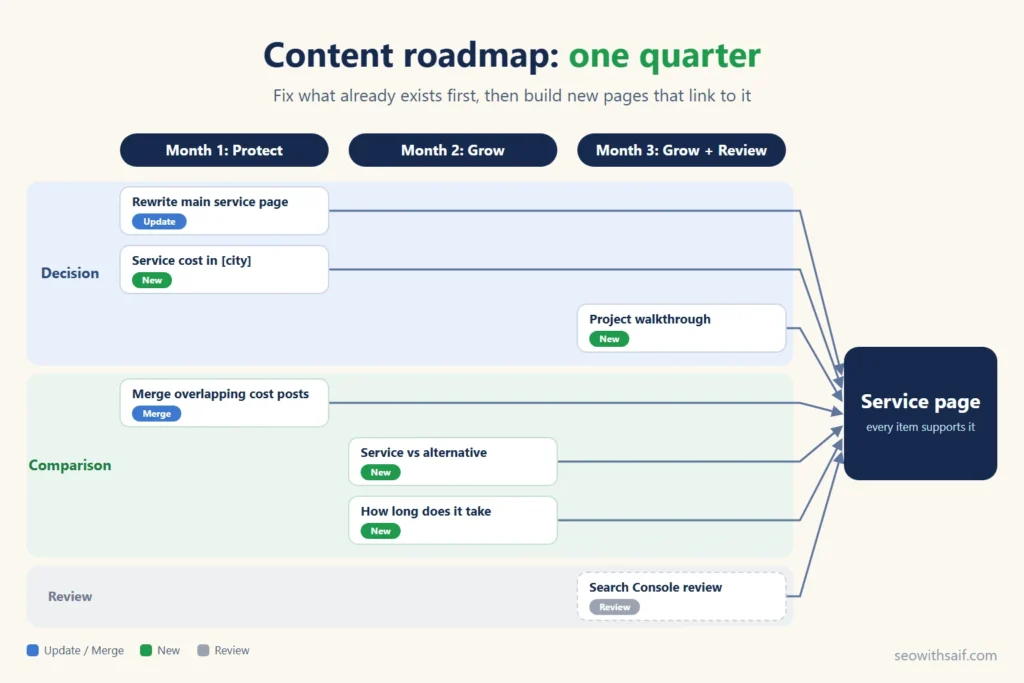
Start with one measurable goal for the quarter, then audit what you have already published. Research keywords and group them into topic clusters, map the search intent behind each one, and sequence the clusters by business value. Finish by assigning owners and rough dates. The order matters more than the tooling. A spreadsheet works fine if the thinking behind it is sound.
Q 4. How should you use keyword data when creating a content roadmap?
Use it to pick clusters, not individual post ideas. Group related keywords by the intent behind them, then judge each cluster against your site’s current authority instead of chasing raw volume. A 300-search keyword you can win beats a 10,000-search one you cannot. Keyword data decides the sequence too: clusters closest to revenue and weakest in competition ship first. Volume alone should never set the order.
Q 5. What are the 5 pillars of content strategy?
The most common version is: a defined audience, clear business goals, core content themes and formats, distribution channels, and measurement. Different frameworks swap in brand positioning or governance, so the exact five vary by source. What stays constant is that the roadmap is where those pillars turn into a concrete production plan with dates and owners attached.
Q 6. What is the 3-3-3 rule in marketing?
It is a simplification framework, usually defined as three core messages, aimed at three audience segments, across three channels. Some versions use three content types across three buyer journey stages instead. Either way, the idea is focus over sprawl, which is the same principle a content roadmap applies to publishing: fewer directions, executed properly, beat scattered effort.
Q 7. Can ChatGPT create a content roadmap?
It can draft topic ideas and a structure quickly. What it cannot do on its own is see your Search Console data, know which pages already rank or compete with each other, or judge which topics lead to revenue for your business. Use it for a first draft, then check every item against your own performance data.
Q 8. How often should a content roadmap be updated?
Review it monthly and rebuild it each quarter. The monthly check confirms whether published items are gaining impressions. The quarterly rebuild resets priorities based on what worked, what changed in search demand, and any algorithm updates that shifted rankings.
Get a Roadmap Built From Your Actual Data
If your blog is busy but your traffic is flat, send me your site through the contact page. I will take a first look at your existing content and reply within two working days with what I see, no charge and no obligation. If it makes sense to go further, I will scope a full audit and roadmap so you know exactly what you would get before committing.