Your traffic looks healthy but your inbox is quiet. Visitors arrive, scroll around, and leave without buying, calling, or filling in a form. That gap between visits and action is exactly what conversion rate optimization exists to close. CRO is the systematic process of increasing the percentage of visitors who take the action you want, whether that is a purchase, a quote request, or a booked call. I spend most of my time getting sites traffic, and I can tell you plainly: traffic that does not convert is a cost, not an asset.
What Conversion Rate Optimization Actually Means
Your conversion rate is a simple calculation: conversions divided by total visitors, multiplied by 100. If 1,000 people visit your service page this month and 20 of them submit the enquiry form, that page converts at 2 percent.
CRO is the discipline of moving that number up without needing more traffic. It works through a repeatable loop:
- Measure where visitors currently drop off, using analytics, heatmaps, or session recordings
- Diagnose why they leave at that point, which is usually friction, confusion, or missing trust
- Change one thing based on that diagnosis
- Test whether the change actually moved the number before rolling it out everywhere
For context on what counts as normal, benchmark research from WordStream and Invesp puts most websites between 2 and 3 percent on average, with top performers converting several times that. If your site sits below 1 percent, something specific is broken, and it is usually findable.
Why Traffic Fails to Convert
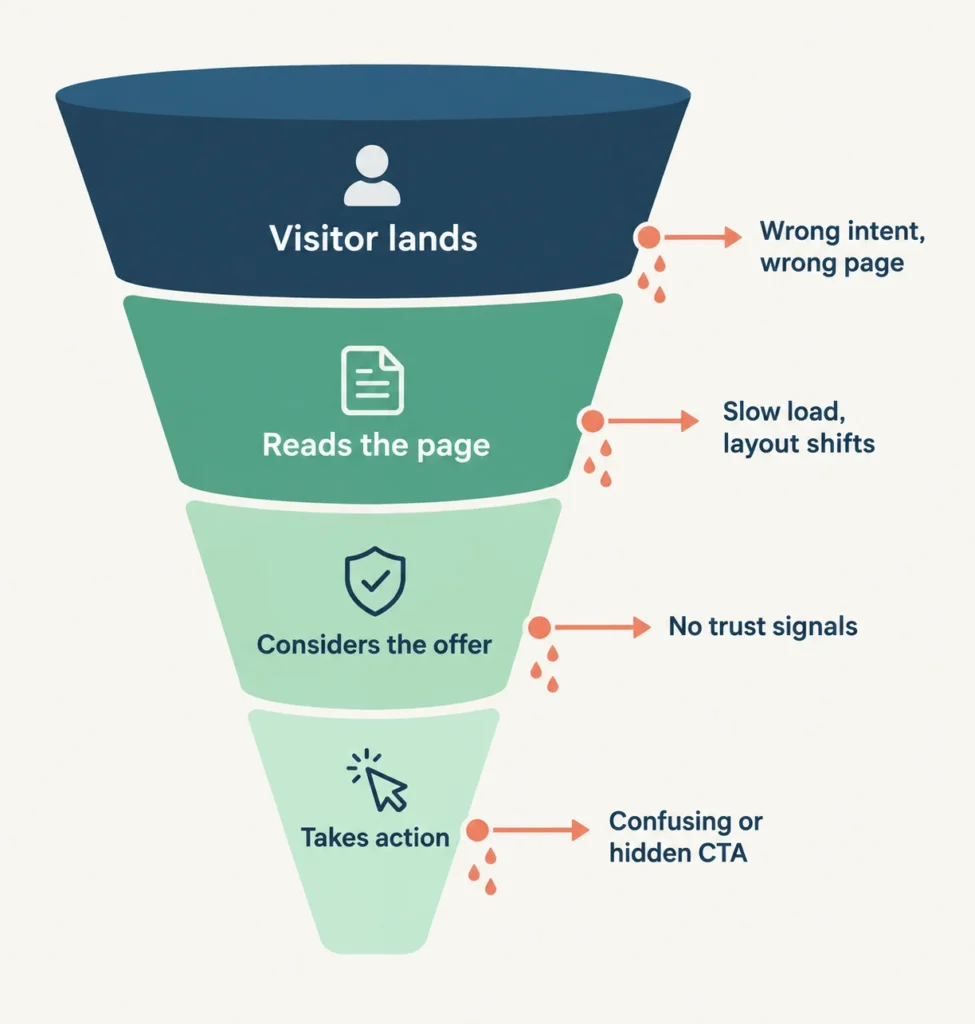
When a business owner shows me a site with decent traffic and almost no leads, the cause is rarely what they expect. Most assume the design is ugly or the price is wrong. In the sites I audit, the most common cause is intent mismatch: the pages pulling the traffic are informational blog posts, and there is no clear path from those posts to the page where money changes hands. The visitor got their answer and left, because nothing invited them further.
After intent mismatch, the usual suspects line up in a fairly consistent order:
- Friction in the ask. Forms with seven fields when three would do, or a contact page with no phone number for people who prefer to call.
- Slow or unstable pages. A page that shifts around while loading loses mobile visitors before they see the offer. I covered the measurable side of this in my breakdown of what actually affects rankings, and the same metrics punish conversions.
- No proof. Zero reviews, no real photos, no named humans. Visitors cannot tell you apart from a scam site, so they leave to find someone they can verify.
- A weak or buried call to action. If the next step is not obvious within seconds, most people will not hunt for it.
How SEO and CRO Work Together
These two disciplines get treated as rivals, and that framing costs businesses money. SEO fills the funnel. CRO stops the funnel leaking. Doing one without the other means either an empty funnel that converts well or a full funnel that converts nothing.
| SEO | CRO | |
|---|---|---|
| Goal | Bring qualified visitors to the site | Turn those visitors into customers |
| Main lever | Rankings, content, technical health | Page design, copy, forms, trust, speed |
| Measured by | Traffic, impressions, positions | Conversion rate, leads, revenue |
| Timeframe | Months to compound | Individual changes can show results in weeks |
| Fails when | Content misses search intent | Pages create friction or doubt |
The overlap is bigger than most people realize. Matching search intent, improving page speed, and structuring content clearly serve both at once. A page built for the searcher tends to rank better and convert better, which is why I treat CRO checks as part of the on-page work I do rather than a separate project bolted on later.
Where I Would Start on Your Site
You do not need expensive testing software to begin. My first pass on any site follows the same order:
- Find the money pages. Identify the three pages closest to revenue and check how much traffic actually reaches them, versus dying on blog posts with no internal path forward.
- Check intent alignment. Read each ranking page and honestly ask whether it matches what the searcher wanted. If your traffic problem runs deeper than conversions, start with this diagnostic instead.
- Load the site on a cheap phone over mobile data. Not your office wifi. What you experience is what most visitors experience.
- Count the steps to convert. Every extra field, click, and decision loses a percentage of people. Cut anything that is not essential.
- Add proof near the ask. Reviews, real numbers, real photos, placed next to the form or button, not on a separate page nobody visits.
Only after those basics are fixed does A/B testing make sense. Testing button colors on a page with an intent mismatch is rearranging furniture in a house with no roof. Definitions and testing methodology are covered well in Optimizely’s CRO glossary if you want the formal version.
Over the course of our 8-month collaboration, his strategies led to over 400% increase in customer leads, helping us outperform even larger competitors in our saturated industry.
— Alessio Ligabue, Services Provider (Italy)
One honest limit. CRO improves the percentage, but it cannot fix a broken offer or bring the wrong audience to the right page. If the traffic itself is unqualified, conversion work polishes a page nobody wanted to land on. That diagnosis has to come first, and it depends entirely on your situation.
Working with Muhammad and his team has been a key driver in obtaining new leads for our B2B SaaS product. I am extremely happy with his SEO expertise and content writing, and would highly recommend him.
— Brandon Parham, Cleri (USA)
FAQs About Conversion Rate Optimization
What is the difference between SEO and CRO?
SEO brings qualified visitors to your website through search rankings. CRO turns those visitors into customers once they arrive. SEO is measured in traffic and positions, CRO in leads and revenue. They share ground: search intent, page speed, and clear structure improve both. A site usually needs both working together, since traffic without conversions earns nothing and a well-converting page without visitors converts nobody.
What is the difference between CVR and CTR?
CTR, click-through rate, measures how many people who see something click on it, such as a search result or an ad. CVR, conversion rate, measures how many people who arrive on your page complete the goal action. CTR gets people in the door. CVR measures what happens after. A high CTR with a low CVR usually means your ad or listing promises something the page fails to deliver.
How to optimise conversion rate?
Start by finding where visitors drop off using your analytics, then fix the leaks in order of impact. The usual sequence: match each page to the search intent bringing its traffic, speed up mobile load times, shorten forms, make the call to action obvious, and place reviews or proof next to it. Change one thing at a time and measure, otherwise you cannot tell what worked.
What are some examples of conversion rate optimization practices?
Common practices include A/B testing headlines and calls to action, cutting form fields down to essentials, adding customer reviews beside the buy button, improving page load speed, simplifying checkout to fewer steps, using session recordings to spot confusion, and adding a phone number for visitors who will never fill a form. The best practice of all is matching the page to what the visitor came searching for.
Find Out Where Your Visitors Drop Off
If your site gets traffic but the enquiries are not coming, send me the URL through the contact page. I will take a first look at your money pages and traffic patterns, then reply within two working days with the most likely leak and what fixing it involves. No charge for the first look, and you keep the findings either way.