
Someone ran your page through the Zuhio keyword count checker, told you the density was too low or too high, and now you are rewriting copy that was fine to begin with. I see this every few weeks. A business owner gets a number, treats the number as the diagnosis, and spends a weekend adding or removing a phrase that was never the reason the page was stuck. The tool is not the problem. The tool is a word counter, and it does that job well. The problem is what people conclude from it.
What the Zuhio keyword count checker actually measures
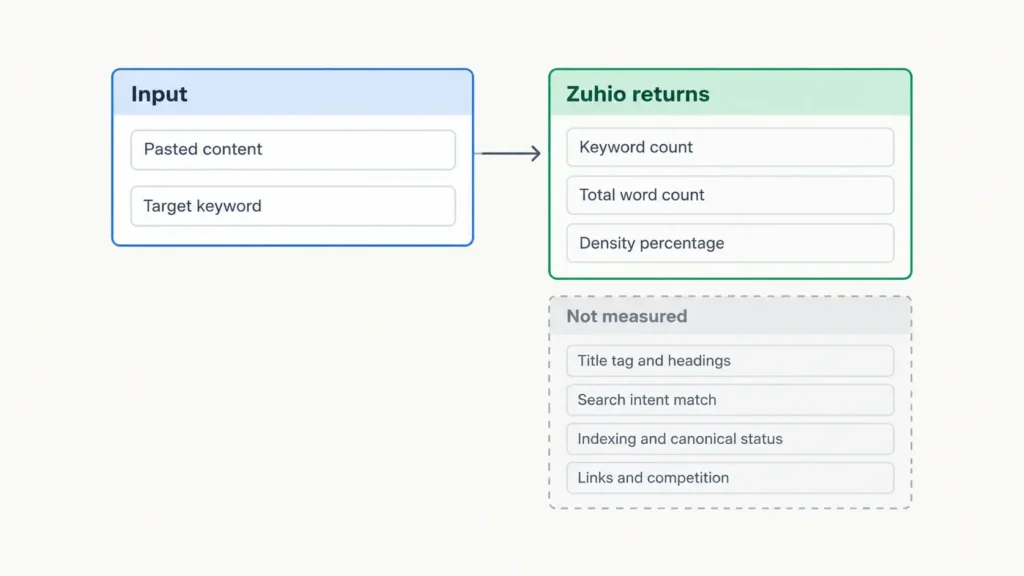
Zuhio’s checker does one thing. You paste your text, type the keyword or phrase you care about, and it returns three figures: how many times the phrase appears, the total word count, and the first divided by the second as a percentage. It handles multi-word phrases, needs no account, and runs in the browser.
That is the entire feature set, and it is worth being precise about what is missing.
- It does not fetch a live URL, so it cannot see your title tag, headings, image alt text or anything outside the pasted body.
- It has no idea what the page is trying to rank for or who else ranks for it.
- It cannot tell you whether the page is indexed, canonicalised correctly, or linked from anywhere.
- It knows nothing about search volume, intent or competition.
None of that is a criticism. A tape measure does not tell you whether the wall is load bearing either. The mistake is asking a counting tool a ranking question.
Keyword density is not why your page is stuck
Google has been unusually consistent about this for over a decade. When John Mueller was asked on Reddit whether keyword density was still a ranking factor, his entire answer was “no”. There is no target percentage inside Google’s systems. The 1% to 2% figure that every density tool quotes, Zuhio included, is a convention that tool makers inherited from each other, not something Google has ever published.
What Google does publish is the failure mode at the far end. Its spam policies describe keyword stuffing as filling a page with words or numbers to manipulate rankings, with the giveaway being repetition that reads unnaturally or blocks of city names bolted on for coverage. Notice what that definition turns on. It is about whether the repetition serves the reader. It is not a threshold.
So a density reading of 0.4% does not mean Google cannot tell what your page is about, and 3.5% does not mean you are about to be penalised. Both numbers are describing your writing. Neither is describing your ranking.
What I find instead when density gets blamed
Across the pages I audit where the owner was told to fix density, the actual cause almost always sits in one of five places, and a count checker cannot see any of them.
| What the owner was told | What the checker showed | What was actually wrong |
|---|---|---|
| “Density too low” | 0.3% | Primary phrase missing from the title tag entirely |
| “Density too low” | 0.5% | Page answered a different intent than the query, usually commercial vs informational |
| “Density fine” | 1.4% | Two pages on the same site competing for the same term, splitting signals |
| “Density too high” | 2.8% | Page was not indexed; the density was irrelevant because nobody could see it |
| “Density fine” | 1.1% | No internal links pointing at the page, so it had no authority to rank with |
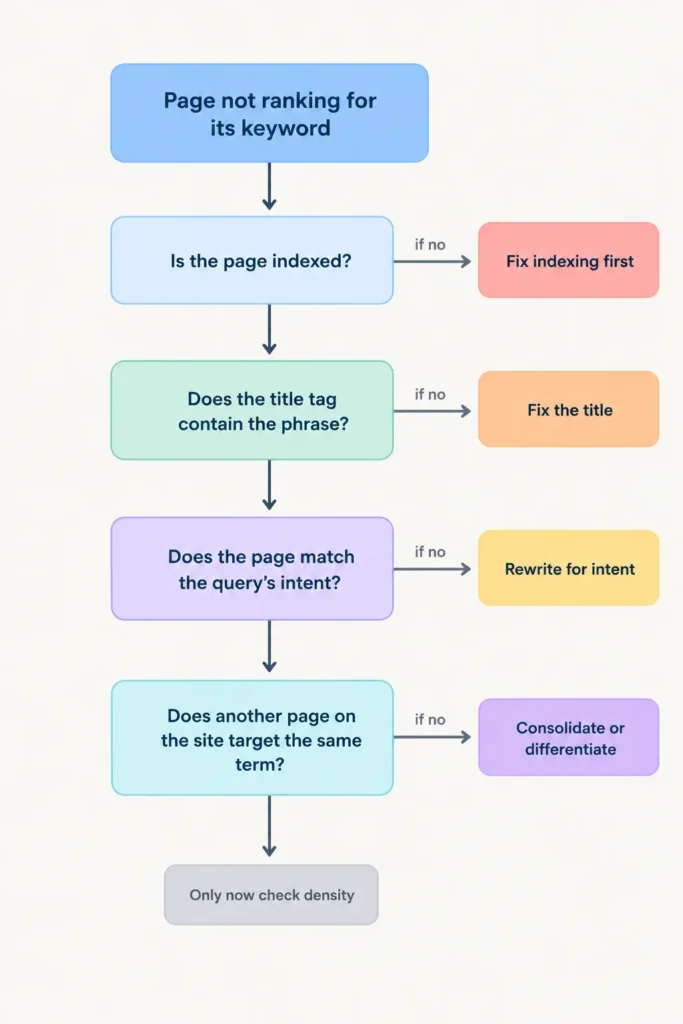
The title tag one is the most common by a wide margin. Semrush’s crawl of 100,000 sites, published in 2016 and still the largest public study of its kind, found duplicate title tags on 35% of them. Old data, but the pattern has not changed in my work since. A page can mention its keyword twelve times in the body and still lose to a competitor who put it once in the title.
If you want to check the things that do move rankings, my why is your SEO not working walkthrough covers the diagnostic order I use, and the technical audit checklist covers the indexing side.
“Working with Muhammad and his team has been a key driver in obtaining new leads for our B2B SaaS product. I am extremely happy with his SEO expertise and content writing, and would highly recommend him. For founders looking for a solid GTM strategy or continuing service, Muhammad is your guy!!!” – Brandon Parham- Cleri (USA)
Where a count checker earns its place in real work
I do use tools like this. Not to hit a percentage, but for three specific jobs where a fast count beats reading a 2,000 word draft twice.
- Catching accidental repetition. After a long editing session I stop noticing that I have used the same phrase in four consecutive paragraphs. A count surfaces it in seconds.
- Confirming placement, not volume. I paste the title, the first paragraph and the H2s separately to check the primary phrase appears once in each. That is a placement check, and it matters far more than the body density.
- Verifying a brief was followed. When a writer is given a primary and two secondaries, running the draft through a checker confirms all three made it in before I read for quality.
Notice that none of those uses treat the percentage as a target. The number is a prompt to go and look at the sentence, not a score to optimise toward. Used that way, Zuhio is a perfectly good tool. It is free, it is fast, and it stays out of the way, which I cannot say about most heavier keyword platforms.
FAQ
Is the Zuhio keyword count checker free?
Yes. It runs in the browser at zuhio.com with no account, no install and no payment step. Be aware that at least one lookalike domain has appeared using the tool’s name, so check the address bar before pasting client content into anything. The genuine tool sits at zuhio.com.
What is a good keyword density?
There is no correct answer because Google does not use density as a ranking input. The 1% to 2% range you will see quoted, including inside the tool itself, is a tool-maker convention rather than a Google guideline. Treat a reading well outside that range as a reason to reread the copy for awkwardness, nothing more.
Will fixing my keyword density improve my rankings?
On its own, almost never. If the page is not indexed, has the wrong title, answers the wrong intent, or competes with another page on your own site, adjusting the body copy will not move it. Fix those first. If all four are sound and the page still reads as repetitive or vague, then a density check can help you tighten it.
Can I paste a URL instead of text?
The genuine Zuhio tool works on pasted text only, so it never sees your title tag, meta description or headings. If you want to check those, paste them in separately rather than assuming the body count covers the whole page. The elements outside the body are usually the ones that matter most.
Find out what is actually holding the page back
If a page has been stuck for months and the only diagnosis you have received is a density percentage, send me the URL and the phrase you want it to rank for. I will check whether it is indexed, whether the title and intent are right, and whether anything on your own site is competing with it. You get a short written answer within two working days covering what is wrong and what to change first. If the fix is small enough to do yourself, I will tell you exactly what it is.
Send me the page and I will take a look.